
State aid in the EU: an evolving landscape
Prepared by Roberto Bernasconi, Emma Domingo Enrich, Vasileios Kostakis, Steffen Osterloh and Lucia Quaglietti
State aid expenditure in the EU has risen sharply in recent years, driven by economic shocks and a global resurgence of interventionist industrial policy. This has triggered a wider debate, with proponents underscoring the need for public intervention to address market failures and strategic vulnerabilities (Evenett et al., 2024), and critics cautioning against the attendant risks of inefficiency, rent seeking and Single Market fragmentation (Hodge et al., 2024). From an ECB perspective, State aid warrants attention due to its implications for fiscal policy, resource allocation and competition. Against rising geopolitical tensions and new EU State aid Temporary Frameworks permitting a more flexible deployment of aid (most recently in support of sectors affected by the Middle East crisis), this box examines its evolving role and allocation.
State aid covers public interventions that provide financial support to firms or confer a selective advantage. Such measures are generally prohibited under Article 107 of the Treaty on the Functioning of the European Union, as they can distort competition in the Single Market. However, the Treaty leaves room for a number of exemptions. To be compatible with the Single Market, State aid must facilitate the development of an economic activity and must not adversely affect trading conditions among Member States to an extent contrary to the common interest.[1]
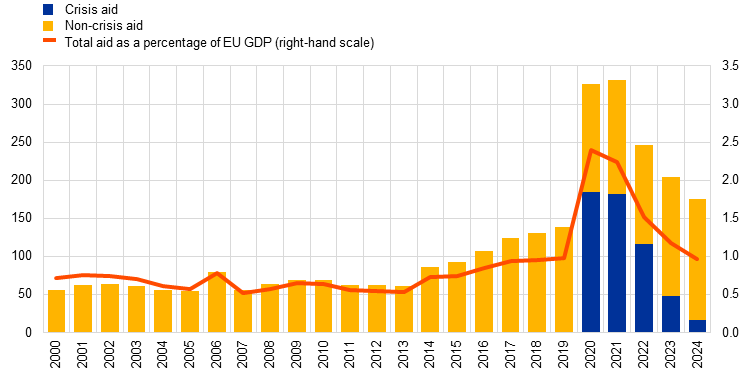
Despite legal constraints, the scope and scale of State aid have expanded markedly over time. Between 2000 and 2013, State aid expenditure remained broadly stable at 0.5-0.8% of GDP. From 2014, reforms expanding the categories of aid exempt from approval by the European Commission enabled Member States to provide support more flexibly, with expenditure almost doubling by 2019.[2] Aid rose further in 2020 and 2021, peaking at €330 billion (2-2.5% of GDP), driven by Temporary Frameworks introduced during the COVID-19 pandemic and extended following Russia’s full-scale invasion of Ukraine. Although it fell to 1% of GDP in 2024, State aid remains above historical averages (Chart A, panel a). More recently, the conflict in the Middle East has led the Commission to adopt a new Temporary Framework, relaxing the conditions under which EU Member States may grant aid to acutely affected sectors.[3]
Chart A
State aid expenditure by policy objective
a) Crisis and non-crisis State aid in the EU
(left-hand scale: EUR billions; right-hand scale: percentages of EU GDP)
b) Non-crisis aid
(left-hand scale: EUR billions; right-hand scale: percentages of EU GDP)

Sources: State Aid Scoreboard, Eurostat and ECB calculations.
Notes: The panels show nominal aid expenditure approved by the European Commission or granted under exemption rules, reflecting the economic advantage conferred on beneficiaries. Panel a) decomposes State aid into crisis and non-crisis aid. Panel b) further decomposes non-crisis aid.
The orientation of State aid has also shifted, including towards broader industrial priorities. Historically, the support targeted innovation, regional cohesion and financing constraints for smaller firms. More recently, it has become increasingly linked to environmental protection, including decarbonisation, as well as industrial competitiveness and strategic resilience (Chart A, panel b). EU policy initiatives like the European Chips Act, the Net-Zero Industry Act and, more recently, the Clean Industrial Deal and the proposed Industrial Accelerator Act, have altered State aid frameworks in support of decarbonisation, energy security and competitiveness. Energy-related aid has grown significantly, reflecting its strategic importance amid elevated energy prices and the severe shocks that have hit the EU economy.[4]
The growth in spending on Important Projects of Common European Interest (IPCEIs) since 2018 illustrates a shift towards a more strategic use of State aid. IPCEIs enable Member States to finance large-scale, cross-border projects addressing market failures and reducing dependencies in strategic sectors like batteries, hydrogen, microelectronics and health technologies.[5] Combining public and private funds, IPCEIs span complex value chains across multiple countries. With approved aid and associated private investment reaching roughly €90 billion (0.45% of GDP) by 2024, they are now among the EU’s most significant coordinated industrial policy instruments, while new dedicated EU-level financial instruments have been proposed by the Commission as part of a European Competitiveness Fund for the Multiannual Financial Framework 2028-2034.
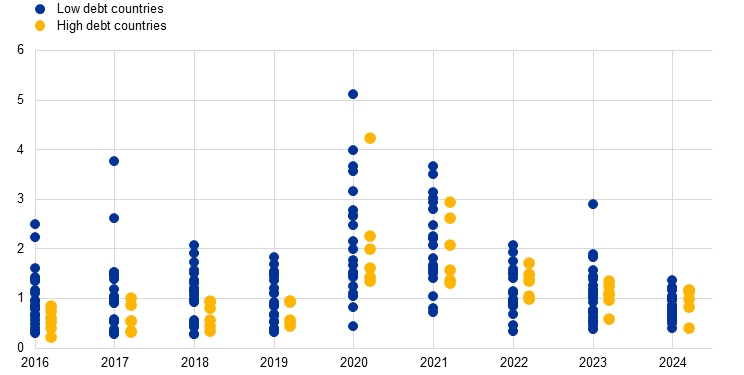
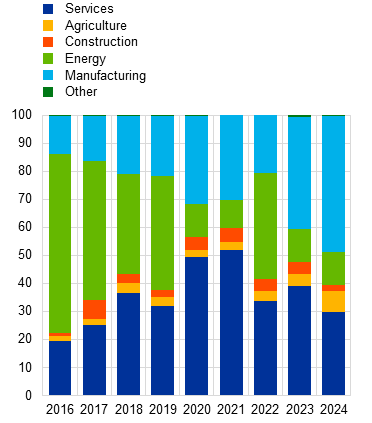
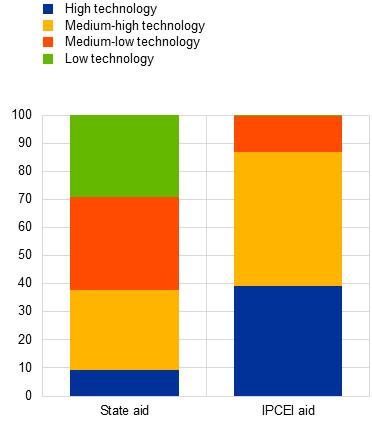
State aid is unevenly distributed across countries and sectors, reflecting differences in fiscal capacity, structural characteristics and policy priorities. During the pandemic, cross-country disparities widened significantly, with several EU countries deploying aid in excess of 3% of GDP in 2020 and 2021, while support remained more limited in others (Chart B). Until 2019 high debt countries tended to spend less on State aid, but the differences have since narrowed. Sectoral allocation has also evolved: firm-level data show that, historically, energy firms received the bulk of the aid (Chart C, panel a), but support shifted towards services during the pandemic, while manufacturing gained in importance after the pandemic. In addition, while standard State aid is broadly distributed across technology levels, IPCEIs focus on high and medium-high technology manufacturing sectors (Chart C, panel b), underscoring their role in fostering strategic value chains.
Chart B
Dispersion of State aid expenditure in EU countries
(percentages of GDP)
Sources: State Aid Scoreboard, Eurostat and ECB calculations.
Note: High debt countries are countries with a debt level greater than 90% of GDP in 2024.
Chart C
State aid expenditure by sector and technology level
a) State aid expenditure by sector |
b) State aid expenditure by technology level and aid type |
|---|---|
(percentages) |
(percentages) |
 |
 |
Sources: State Aid Transparency database, European Commission and ECB calculations.
Notes: Figures are based on firm-level data and show aid awarded across 23 EU countries (excluding Spain, Poland, Romania and Slovenia). The services category excludes information and communications technology. Data in panel a) refer to about 70% of total aid reported in Chart A. Panel b) shows the composition of general State aid and aid provided to manufacturing firms under the IPCEI framework by technology level (see High-tech classification of manufacturing industries).
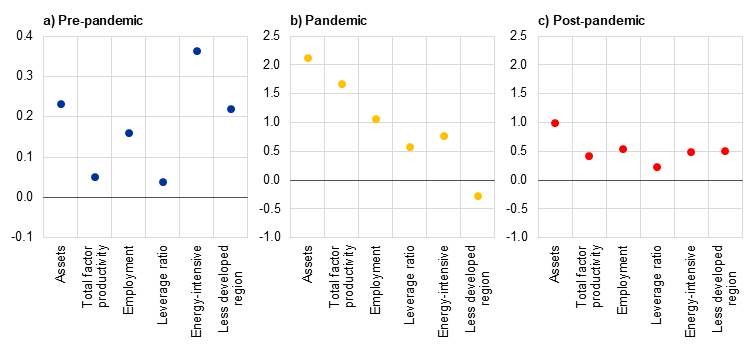
After the pandemic, State aid shifted from crisis-driven liquidity support towards a more selective, competitiveness-oriented allocation. The evolving objectives of State aid are also reflected in the composition of firms receiving it. Using a panel of five million EU firms over the period 2016-2024, we estimate the probability of receiving aid based on firm characteristics.[6] Before the pandemic, large firms, firms in energy-intensive sectors and firms in less developed regions were more likely to receive support, with estimated increases in probability ranging from 0.2 to 0.4 percentage points (Chart D, panel a).[7] During the pandemic, size and productivity remained important, but financial constraints emerged as a key factor, with highly leveraged firms significantly more likely to receive support. At the same time, firms in less developed regions became less likely to receive support (Chart D, panel b). Size and productivity continued to be important determinants of aid allocation in the post-pandemic period. In contrast, the role of leverage has become less pronounced compared with the pandemic period, while firms located in less-developed regions have once again become more likely to receive support (Chart D, panel c).
Chart D
Probability of receiving State aid based on firm characteristics
(percentage points)
Sources: State Aid Transparency database, Orbis database and ECB calculations.
Notes: The chart shows estimated marginal effects from a linear probability model. Coefficients are percentage point changes in the probability of receiving aid relative to non-recipients. Each marker represents the estimated effect of a one standard deviation change in a given firm characteristic. Confidence intervals are narrow and therefore not shown.
State aid in the EU has expanded, becoming increasingly flexible and more aligned with shifting policy priorities in the EU. As industrial policy gains prominence globally and the EU is negotiating its new Multiannual Financial Framework for the period 2028-2034, these developments raise critical questions about how State aid can effectively support shared EU objectives and new policy priorities while safeguarding competition within the Single Market and maintaining fiscal sustainability. Further analysis is warranted to examine these issues in a comprehensive way.
References
Evenett, S., Jakubik, A., Martin, F. and Ruta, M. (2024), “The Return of Industrial Policy in Data”, IMF Working Papers, Vol. 2024, No 001, International Monetary Fund, January.
Hodge, A., Piazza, R., Hasanov, F., Li, X., Vaziri, M., Weller, A. and Wong, Y.C. (2024), “Industrial Policy in Europe: A Single Market Perspective”, IMF Working Papers, Vol. 2024, No 249, International Monetary Fund, December.
Legal Disclaimer:
EIN Presswire provides this news content "as is" without warranty of any kind. We do not accept any responsibility or liability for the accuracy, content, images, videos, licenses, completeness, legality, or reliability of the information contained in this article. If you have any complaints or copyright issues related to this article, kindly contact the author above.
